A Choice That Shapes More Than Just the House
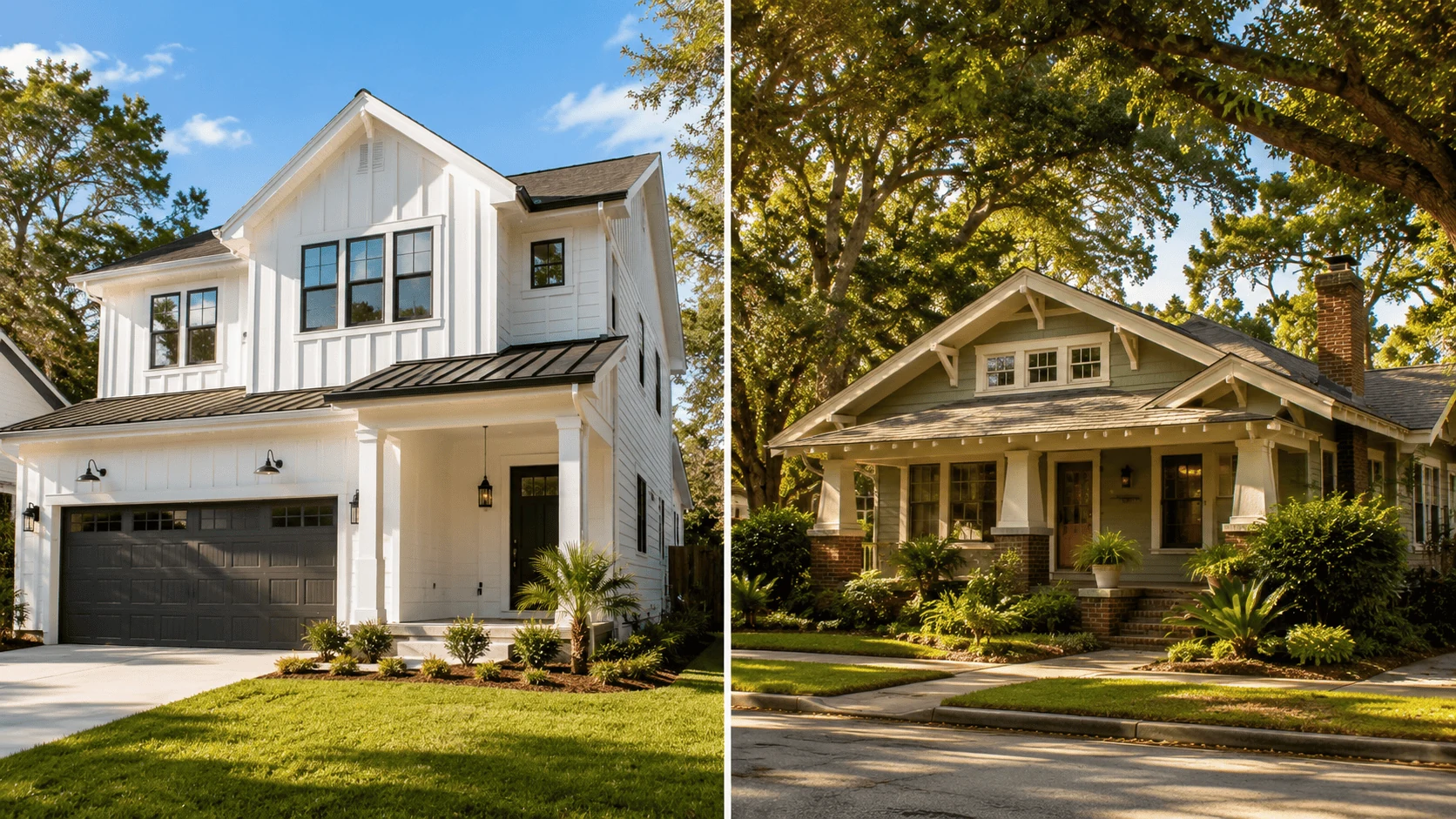
When buyers in Pensacola begin their search, many arrive with a strong intuition about which direction they want to go — new construction or existing home. Some want the clean slate and modern systems of a new build. Others want the established character and mature landscaping of an older neighborhood. Both are legitimate preferences, and both paths lead to genuinely good homes.
What buyers sometimes underestimate is how differently these two paths work from a practical standpoint — the timeline, the process, the costs, the risks, and the financial dynamics at closing. After working with buyers across both categories for 22 years in this market, I've found that the clearest service I can offer is an honest comparison.
The Case for New Construction in Pensacola
New construction in the Pensacola area continues to expand — particularly in the northern reaches of Escambia County, in Santa Rosa County, and in master-planned communities along the I-10 corridor. Here is what buyers get with new construction:
Modern systems with known service lives. A new home's HVAC, roof, electrical, and plumbing all start fresh. You know exactly how old everything is, you typically have manufacturer warranties, and you can build your first decade of homeownership around gradual maintenance rather than immediate replacement costs.
Builder warranties. Most new construction in Florida comes with a standard builder's warranty: one year on workmanship, two years on mechanical systems, and ten years on structural defects. These protections are meaningful and transfer with the home.
Energy efficiency. Homes built to current Florida building codes are significantly more energy-efficient than homes built 20–30 years ago. Better insulation, low-E windows, and modern HVAC equipment reduce utility costs meaningfully over time.
Lower near-term insurance friction. New construction typically qualifies for maximum wind mitigation discounts because it was built to current code. The roof is new, the opening protections are code-compliant, and the electrical is up to date — the combination often produces significantly lower insurance premiums than comparable older homes.
The Case for Existing Homes in Pensacola
The existing home market in Pensacola offers something new construction simply cannot: established neighborhoods with character, mature landscaping, walkable proximity to Pensacola's cultural fabric, and locations that no longer have buildable land.
Location. East Hill, the historic blocks of Midtown, the bayfront streets of Navy Point, the established blocks of Gulf Breeze — these neighborhoods are built. The lots are occupied. The only way to buy into them is to buy an existing home. New construction cannot replicate location.
Immediate community. Established neighborhoods have a social and physical maturity that takes decades to develop — mature trees, sidewalks that connect to places, neighbors who have been there for years. Many buyers find this quality worth significant trade-offs.
Price per square foot. In many segments of the Pensacola market, existing homes offer more square footage and lot size for the dollar than new construction of comparable quality. New construction carries developer margin, current labor and materials costs, and often HOA fees that didn't exist in older neighborhoods.
Character and craft. Pre-1970s homes in Pensacola often feature construction quality — solid wood flooring, plaster walls, old-growth lumber framing — that cannot be replicated at accessible price points today.
The Trade-Offs on Each Side
New Construction Trade-Offs
New construction typically takes 6–18 months to complete from contract, depending on the builder and the stage of construction at purchase. That timeline requires buyers to be more patient and more flexible. Builder contracts are written to protect builders, and buyers should have them reviewed by a real estate attorney before signing.
Community amenities in new developments — parks, trails, pool facilities — are often promised but may take years to fully materialize. And while master-planned communities offer consistency, they can also feel uniform in ways that established neighborhoods do not.
Existing Home Trade-Offs
The primary trade-off in existing homes is condition uncertainty. Even with thorough inspection, an older home carries more unknowns than a new one. Systems will eventually need replacement. There may be deferred maintenance from previous owners. Older homes in coastal Florida also carry more complex insurance dynamics — four-point inspections, potential insurability concerns, and in some cases the need to upgrade systems before a carrier will write a policy.
How to Decide
The practical question is not which path is better — both produce happy homeowners every day. The question is which trade-offs fit your situation. If you have flexibility on timeline, want minimal near-term maintenance, and prioritize school zones in newer master-planned communities, new construction deserves a close look. If location is paramount — you need to be in a specific neighborhood, near a specific school, or close to downtown and the water in ways new development can't offer — an existing home is almost certainly the right path.